
Why Is My PDF So Large? 15 Causes and How to Reduce It
Page count rarely tells the whole story. Use these 15 causes to find what is occupying space before you compress or rebuild the PDF.
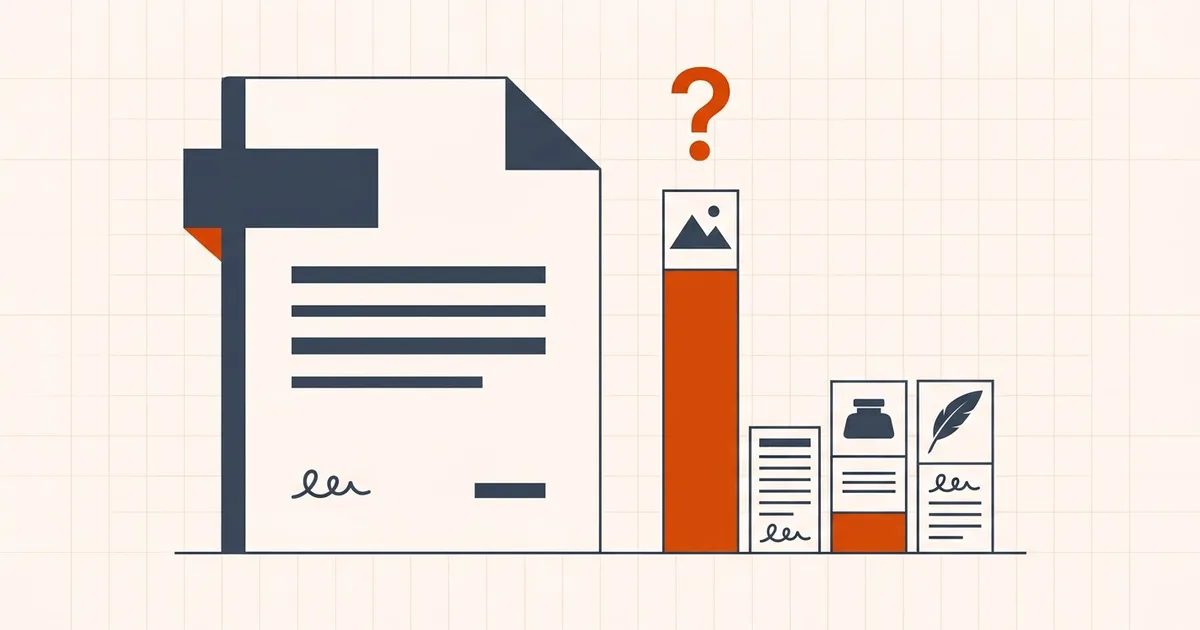
A three-page scan can outweigh a hundred-page text report. The useful question is not “How many pages?” but “What objects did the creator place inside those pages?”
A 30-second diagnosis before you do anything
Divide the file size by the page count. The result points at the cause more reliably than anything else you can check without tools.
| Size per page | What is almost certainly inside | Fix that usually works |
|---|---|---|
| Under ~100 KB | Typed text and fonts, few or no images | Little to gain from image compression; re-export with font subsetting if it must shrink |
| ~100 KB – 500 KB | Text with logos, screenshots or a few photos | Moderate image recompression, check logos and charts afterward |
| ~500 KB – 1 MB | Mixed pages, or a grayscale scan | Image recompression normally brings this down substantially |
| 1 MB and above | Full-page color scans or camera photos at native resolution | Recompress, or rescan at 200 DPI grayscale — the largest savings on this list |
These are rules of thumb, not measurements: an embedded video, a 20 MB attachment, or a CJK font can break the pattern in either direction. The reliable check is a space audit of the file itself.
The limits people are usually trying to get under
“Too big” only means something relative to where the file is going. These are the ceilings that generate most of the searches for this problem; each links to a guide with the sourced figure and the workflow for that destination.
| Destination | Published limit | Realistic target | Guide |
|---|---|---|---|
| Gmail, Outlook.com, Yahoo | 25 MB per message, measured after encoding | Under 18 MB on disk | Gmail · Yahoo, iCloud, Proton |
| Microsoft 365 / Outlook desktop | 35 MB default; 20 MB client cap on POP/IMAP accounts | Under 25 MB, or 18 MB | Outlook attachment size limit |
| Corporate Exchange Server | 10 MB default | Under 7 MB | Outlook attachment size limit |
| US immigrant visa (NVC / CEAC) | Roughly 2 MB per document | Well under 2 MB | NVC / CEAC 2 MB limit |
| Canada (IRCC) | 4 MB or 5 MB per file by account | Under 4 MB | IRCC upload limits |
| UK visa portals | 2–6 MB per file by provider | 10–15% under your portal's cap | UK visa upload limits |
| Australia (ImmiAccount) | 5 MB per attachment | Under 5 MB | ImmiAccount upload limits |
| Messaging apps | Rarely a size problem — the risk is silent recompression | Send as a document, not media | WhatsApp, Telegram, Slack, iMessage |
If none of these is your destination, pick the destination first and work back from its rule. Under 10 MB clears nearly every email system and messaging app; visa and government portals are the ones that need single-digit megabytes.
Is a PDF a document or a container of objects?
A PDF is a container. The bytes you download describe objects — not just the pages you see — so two PDFs that look identical on screen can be encoded very differently.
Pages can reference text, raster images, vector artwork, embedded fonts, annotations, attachments, forms, JavaScript, metadata, output intents, and other objects. Two PDFs that look identical can be encoded very differently.
How do I inspect what is taking up space?
Before you compress a PDF or attempt to repair it, you need to know which internal component is consuming your storage budget. A PDF is not a monolithic block; it is an assembled collection of discrete streams and objects.
- Check document properties: Open the file in any standard PDF reader and check File Properties (or Document Properties). Look at the total file size versus font embedding and page count to get an initial baseline.
- Audit space usage: Professional PDF tools offer an "Audit Space Usage" or object inspection feature that breaks down bytes allocated to images, fonts, forms, and metadata.
- Determine image vs. text weight: Scroll through the document to identify whether pages are high-resolution camera photos / flat scans (which respond well to image compression) or searchable vector text with embedded fonts (where image compression will have little effect).
- Hunt for hidden streams: Check for embedded attachments, incremental save histories, or oversized color profiles that may be lingering behind the scenes.
What are the 15 causes — and the right fix for each?
- High-resolution photographs. Resize or recompress them for the intended viewing size, while retaining the source images.
- Full-page color scans. Rescan with an appropriate resolution and color mode when the original paper is available, or test image recompression carefully.
- Lossless images used for photographs. A photographic image may be much larger in a lossless format; switching encoding can help but is lossy.
- Many separate images. Reports, catalogs, and slide decks can accumulate substantial image data even when each image seems modest.
- Full embedded font programs. Export with font subsetting in the source application. BytesPDF does not subset fonts.
- Duplicated resources. Re-export from the source tool if it embeds repeated copies instead of sharing objects. BytesPDF does not promise complete object deduplication.
- Embedded attachments. Remove an attachment only when it is unnecessary and the document's purpose allows it.
- Forms, annotations, or scripts. These can be legitimate functionality. Do not flatten or remove them merely for size without understanding the consequence.
- Large color profiles or output intents. Print workflows may require them. Ask the printer before stripping color-management data.
- Layers and transparency. Complex design exports can carry additional resources. Re-export from the design source with an appropriate preset.
- Incremental saves and editing history. A clean export or “save as” operation in the authoring tool may rewrite the file more efficiently.
- Print-to-PDF output. Printing can lose links, forms, tags, and other semantics or create less efficient content. Prefer a proper export when the source application provides one.
- Oversized page thumbnails or previews. Some producers store auxiliary images. Use a trusted optimizer that shows what it will remove.
- Poorly chosen export settings. A press-quality preset is inappropriate for some screen-only distribution copies, while a screen preset may be wrong for print.
- The file is already efficient. A text-heavy or previously optimized PDF may have little safe room to shrink. A tiny change is not a failure.
Where do the bytes actually go? Three heavy components
Three components dominate oversized PDFs far more often than raw page count: font programs written without subsetting, private editing data retained by design applications, and dense vector artwork serialized as drawing instructions.
Do embedded fonts make a PDF bigger?
Yes — when the producing application embeds the complete font program instead of only the glyphs actually used. A single embedded Latin typeface commonly adds hundreds of kilobytes, and CJK fonts can add several megabytes each.
The PDF specification expects producers to subset fonts: write only the glyphs the file uses, tagged with a six-letter prefix such as ABCDEF+FontName. Two failure modes inflate files. First, some export paths skip subsetting entirely and ship the full font program. Second, every editing session subsets independently, so a document assembled from many edits or merges can accumulate several overlapping subsets of the same family — ABCDEF+Inter alongside GHIJKL+Inter — each carrying its own embedded data. You can see this with the free pdffonts utility (part of Poppler), which lists every embedded font with its subset status.
The fix lives in the source application: re-export with subsetting enabled, or rebuild from the original document. Because font rewriting can change rendering, BytesPDF does not subset or deduplicate fonts — see why repeated editing makes fonts a size driver for the detailed mechanics.
Does hidden editing data stay inside the file?
Yes, unless it is deliberately stripped. Two common PDF features keep authoring information inside the distributed file, and both add bytes invisible to a reader.
- Application private data. Adobe Illustrator's "Preserve Illustrator Editing Capabilities" option embeds a private copy of the native artwork inside the PDF (as document piece info / Private data). Photoshop's equivalent option does the same with PSD editing data. The file can be dramatically larger than the visible export because it carries two documents: the printable PDF and the editable source.
- Incremental save history. The specification allows applications to save updates by appending new object versions after the existing file body instead of rewriting it. Each quick "save" layers more byte ranges onto the file — and superseded content can remain recoverable, which is a privacy consideration as much as a size one.
The remedy is a full rewrite: "Save As" or a fresh export in the source application. Keep the editing-capable original in your archive and distribute the rewritten copy.
Why does complex vector artwork weigh so much?
Vector pages do not store pixels — they store instructions. Paths, curves, clipping masks, shading patterns, and graphics-state changes serialize as operator streams, and a dense CAD sheet, map, or illustration can contain millions of them.
Stream compression helps but has limits here, and transparency flattening during export can split artwork into thousands of small atomic regions, each with its own graphics state. Image-focused compression cannot touch these streams at all. If the recipient permits, a controlled rasterization or a simplified re-export from the design source is the realistic fix — with the usual warning that rasterizing removes selectable text, so weigh whether the output must stay searchable first.
What order should I diagnose a large PDF in?
- Identify whether pages are scans or searchable born-digital content.
- Check for many photographs, full-page scans, attachments, forms, and specialist print features.
- Return to the source document when possible; a clean export is often more controlled than repairing a finished PDF.
- Use compression only on a copy, then compare the result in a representative viewer.
What can BytesPDF address — and what stays untouched?
BytesPDF is most relevant when supported embedded images are a meaningful part of the file — the scans, photographs, and losslessly-encoded pictures from the lists above. It re-encodes those images and rewrites the PDF, and it reports the before/after sizes so you can judge the result on a copy.
The entire pipeline runs inside your browser tab. The file is read into memory as an ArrayBuffer; image decode and re-encode run in Web Workers — background threads that keep the page responsive — using WebAssembly codecs such as MozJPEG; the document is then rewritten with compact object streams; and the finished file is handed to you as a local Blob URL. Nothing is sent to a server, which you can verify yourself in your browser's Network tab while processing. Because it never uploads, browser memory is the practical limit rather than a plan tier.
Equally important is the boundary. BytesPDF does not provide font subsetting, OCR, full object garbage collection, preflight, or PDF/A validation — so font-heavy, editing-history-heavy, or vector-heavy files from the deep dive above may shrink little. Those limits explain why results vary between files, and they are why checking which component dominates your file should come before any compression attempt. When you are ready, test a copy in the browser-based compressor and inspect the output before distributing it.
How to reduce it once you know the cause
The diagnosis above decides the method; the method decides the tool.
- Images dominate — recompress a copy. The step-by-step, including which level to pick and what to inspect afterward, is in how to reduce PDF file size online for free. Start moderate; scans that must stay legible degrade at the small print first.
- Fonts, editing data or attachments dominate — go back to the source application and re-export with subsetting on and editing capabilities off, or remove the attachment. No image compressor fixes these.
- Vector artwork dominates — simplify or rasterize from the design source, if the recipient allows a non-searchable page.
- Nothing dominates — the file is already efficient. Send a link instead of fighting it.
The choice between a browser-local tool, an upload-based service, a desktop application, or an “AI” compressor matters most when the document is a bank statement, contract, medical record or passport scan. Online, desktop and AI PDF compression compared sets out what each approach does to the file and where the file goes while it happens.
Frequently asked questions
How do I check what inside a PDF is taking up the most space?
You can inspect a PDF using PDF reader properties panels, advanced preflight tools in professional PDF editors, or command-line inspection utilities. Check whether megabytes are consumed by high-resolution raster images, full embedded font programs, hidden attachments, or incremental save history before choosing between image compression and source re-export.
Why is my PDF so big when it only has a few pages?
A PDF is a container. A few pages can hold high-resolution scans, photographs, fonts, attachments, forms, color profiles, and editing data. Those objects matter more than page count. A single full-page color scan at 300 DPI can outweigh a hundred pages of typed text.
How do I make a large PDF smaller for email or an upload portal?
First find out what is using the space. If the file is a scan or contains photographs, recompressing those images in a browser-local tool usually gets it under email and portal limits. If fonts, attachments, or editing history dominate, re-export from the source application instead. Keep the original and check the small print in the output before sending.
Can I reduce PDF size without losing quality?
Sometimes. Removing editing history, duplicated resources, and unused objects is lossless. Reducing image resolution or JPEG quality is not, but for a 300 DPI color scan read on screen the difference is usually invisible. Vector text is never rasterized by BytesPDF, so typed documents keep their sharpness.
What is the most common cause of a large PDF?
Large or numerous embedded images are common, especially full-page scans and camera photos, but the only reliable answer for a specific PDF comes from inspecting its contents and creation workflow.
Will compression affect text?
Born-digital vector text is not rasterized by BytesPDF, but scanned text is image data and can soften. Rewriting can also affect complex document structures, so inspect search, copy, fonts, links, and forms afterward.
Why did my PDF barely shrink?
It may already be optimized, contain little supported image data, rely on formats the current compressor does not rewrite, or be dominated by fonts and structures rather than images.
Related comparisons
Source-led comparisons written by BytesPDF, with the conflict of interest disclosed on each page. They link official provider documentation rather than fabricated tests.