
IRCC (Canada) Document Uploads: 4 MB, 5 MB, and the One-File Rule
IRCC's per-file limit is 4 MB on most accounts and 5 MB on the Portal — and only one file is saved per field. Here is how to work inside both rules.
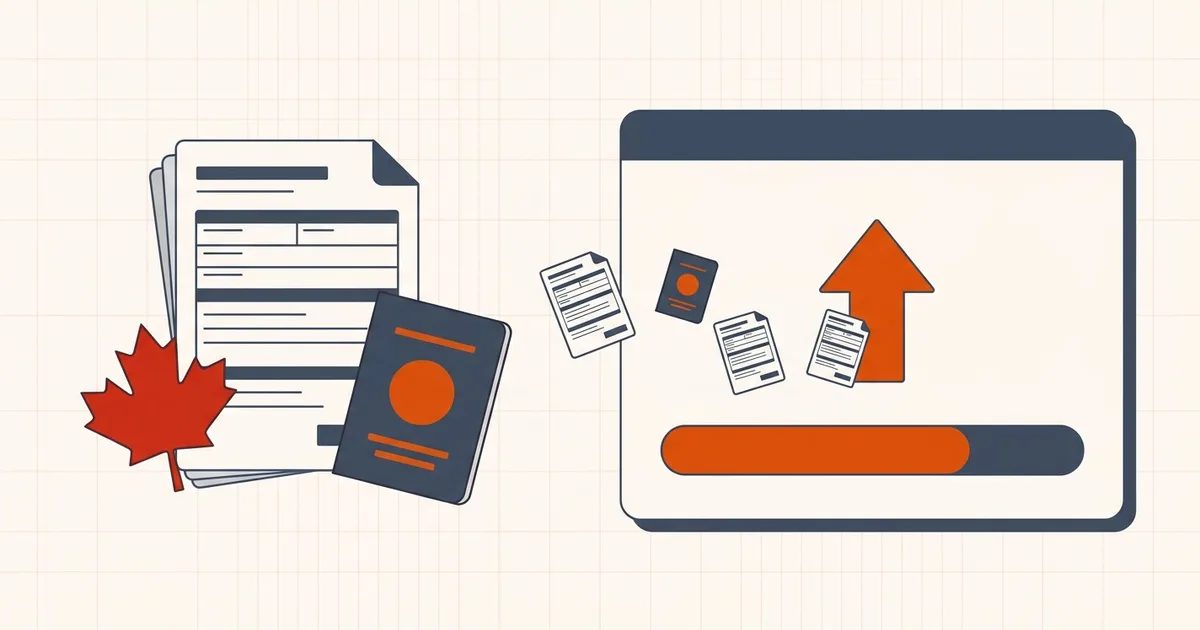
Canadian immigration applications have one rule that trips up almost everyone: one file per field. Not one document — one file. If you upload three PDFs into the same field, IRCC keeps only the last one and silently discards the other two.
Combine that with a 4 MB per-file ceiling and you have a workflow that rewards preparing your documents properly before you ever open the upload page.
The limits by account type
IRCC's help pages list different per-file limits depending on which online account you are using:
| Online account type | Limit per file |
|---|---|
| IRCC secure account | 4 MB |
| IRCC Portal | 5 MB |
| IRCC Portal (new version) | 5 MB |
| Permanent Residence Portal | 4 MB |
| Online citizenship application | 4 MB |
| Asylum portal | 4 MB |
You will also see applicants reporting a 2 MB ceiling on some older flows. Rather than trying to determine which number applies to your exact combination of application and account, use this rule:
Build every file to fit inside 4 MB. If it fits in 4 MB, it fits everywhere.
Accepted formats
IRCC accepts six formats: PDF, TIFF, JPG, PNG, DOC, and DOCX.
In practice PDF is the right answer for almost everything. It preserves formatting across the devices officers use to review files, it compresses well, and — critically — it is the only sensible container when you need to bundle several pages into a single file.
The one-file-per-field rule
This is where most applications go wrong. IRCC states that only one file is saved in each document field, and that uploading more than one means only the last is kept.
So when a field asks for proof of employment for one job, everything relevant — reference letter, pay stubs, contract, tax slips — has to become one ordered PDF before you upload it. Not four files. One.
Two principles keep this manageable:
- Combine only what belongs together. Do not merge unrelated documents just to save space. Follow the field instructions.
- Order matters. Put the documents in a logical sequence — usually the main document first, supporting evidence after — so a reviewer can follow them without hunting.
If you need to combine files, use the merge tool, which also runs locally in your browser.
How much actually fits in 4 MB
| Content | Rough size |
|---|---|
| Text-only PDF, many pages | Very small — hundreds of pages possible |
| Scanned page at 150 DPI, grayscale | 200–500 KB |
| Scanned page at 300 DPI, color | 400 KB – 1 MB |
| High-resolution phone photo | 2–3 MB each |
| 4 MB budget | Roughly 8–10 scanned pages with images |
The pattern is obvious: photographs are what blow the budget. A relationship-evidence bundle made of twenty full-resolution phone photos will never fit. Resize the images first, then build the PDF.
IRCC's own guidance on combining documents suggests saving at 150 DPI or less to reduce size — with the explicit caveat that small text and stamps must remain readable.
A workflow that does not need repeating
- Read the field instructions. Confirm what the field wants and check the stated maximum in the account you are actually using.
- Gather the documents for that single field — and only that field.
- Resize images before combining. Shrink phone photos to a sensible long edge and re-save at moderate quality. Doing this after the PDF is built is far less effective.
- Combine into one ordered PDF using the merge tool.
- Check the size. If it is over 4 MB, compress.
- Compress only if you need to. Open the compress tool and reduce it. These are passports, financial records, and identity documents — the tool processes them in your browser and does not upload them.
- Open the result and inspect every page. Zoom into the smallest text, the stamps, and the signature lines. If anything is illegible, back off and redo it.
- Upload, then confirm it saved. Do not assume.
Details that cause repeat rejections
- Only the last file is kept in a field, so a mis-ordered upload silently loses evidence.
- Filenames matter. Keep them simple and avoid extra punctuation beyond the extension.
- Password-protected and encrypted files will not upload. Remove protection first.
- Low-quality scans delay processing even when they are under the size limit. IRCC warns that illegible documents slow applications down.
- Certified translations usually need to be combined with the original into the same file, which roughly doubles your page count and your size budget.
Official sources
- IRCC secure account — sign in and check which account you need — IRCC runs different accounts for different application types, and the upload limits are shown within the account you use
- Gmail's 25 MB limit, if you need to email documents to a representative
IRCC does not publish one consolidated file-size specification, so the upload page inside your account remains the authoritative source.
Before you upload
- One file per field, with everything combined in a logical order
- Format is PDF, TIFF, JPG, PNG, DOC, or DOCX
- File is under 4 MB
- Images were resized before combining, not after
- Every page opened and checked — small text, stamps, signatures
- No password protection, no ZIP, no spreadsheet
- The original uncompressed files are still on your disk
Frequently asked questions
What is the IRCC file size limit per document?
IRCC's help pages list 4 MB per file for most account types, including the secure account, the Permanent Residence Portal, citizenship, and asylum. The IRCC Portal is listed at 5 MB. Treat 4 MB as your target unless the upload page says otherwise.
What file formats does IRCC accept?
PDF, TIFF, JPG, PNG, DOC, and DOCX. PDF is the safest choice, particularly when you need to combine several documents into one file.
Can I upload multiple files into one IRCC document field?
No. IRCC states that only one file is saved per field — if you upload several, only the last one is kept. Combine related documents into a single ordered PDF before uploading.
How many pages fit into 4 MB?
Roughly 8 to 10 scanned pages at around 150 DPI, and far more for text-only documents. High-resolution photographs consume 2 to 3 MB each, so image-heavy evidence fills the budget quickly.
Related comparisons
Source-led comparisons written by BytesPDF, with the conflict of interest disclosed on each page. They link official provider documentation rather than fabricated tests.