
Ctrl+F Won't Find Words You Can See in a PDF (When Text Is Selectable)
Selectable text should mean searchable text. When it doesn't, the gap is encoding, a lying OCR layer, permissions, or a stale index — a diagnostic order that finds it.
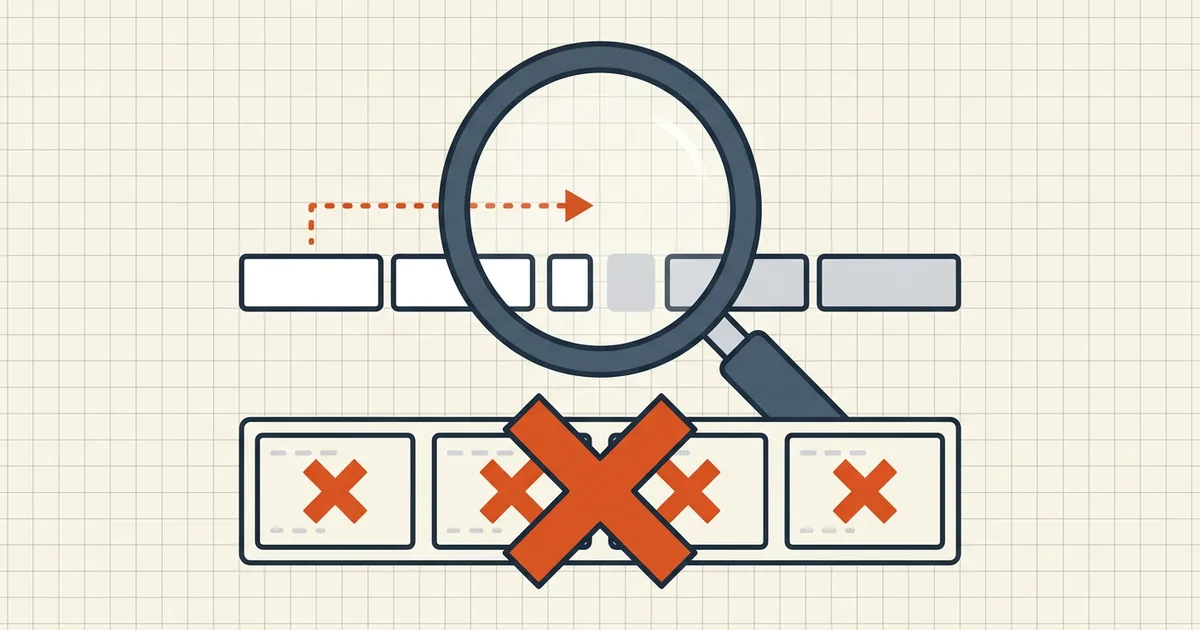
Two different failures wear the same face: “search is broken.” One is a photograph of text. The other — today's subject — is text you can highlight that search still won't match.
Image-only vs layer-lying
| Symptom | Likely type | First move |
|---|---|---|
| Selection draws a big rectangle / nothing | Image-only scan | OCR the scan |
| Letters select, Ctrl+F finds 0 | Encoding / bad layer / permissions | This checklist |
| Paste into Notepad is garbage | Corrupt OCR layer | Rebuild OCR |
| Chrome finds it, Acrobat doesn't | Extraction permission flag | Properties → Security |

Run the order
- Select-all → paste. Clean paste means the layer's text is coherent; dig into encoding and permissions. Garbled paste means rebuild OCR with language packs matching the document (accuracy ladder).
- Retry search without ligature traps: “ice” hits inside “office” when the ffi glyph confuses the matcher.
- Security tab: Content Copying / extraction denied can silence search in strict readers; browsers frequently ignore it — the inconsistency is diagnostic.
- Purge search cache in the reader (Acrobat: Preferences → Search → Purge Cache) — stale indexes cause “known bad” misses on files that used to search fine.
- Partial OCR: cover page searchable, body not — test a middle page, not page one.
What “fixed” means
After a rebuild, spot-check: unique name, an odd number, a hyphenated term. If extract yields clean text (text extraction) and Ctrl+F agrees, the layer is honest. Portal-side search boxes read the same layer — a green light on desktop means filing systems can index it too.
Honest BytesPDF scope
No OCR, no layer repair, no cache purge at BytesPDF. Compress preserves whatever text exists; clean strips metadata; count-words and table extraction require a real layer and report when they can't count. Layer surgery is OCR-tool territory — stated beside our other intentional gaps.
Frequently asked questions
I can highlight the words — why does search still fail?
Highlighting uses the page's text objects; search often needs correct Unicode mapping. Ligatures (ffi as one glyph), subset encodings, or an OCR layer whose character codes don't match what's drawn can all let you select text while Ctrl+F matches nothing. Select-all + paste into an editor: if the paste is garbled, the layer itself is the problem.
What's the five-minute diagnostic order?
(1) Select a word — if selection fails entirely, it's an image; go OCR ([searchable guide](/blog/make-scanned-pdf-searchable)). (2) Select-all → paste: garbled ⇒ rebuild OCR ([accuracy tips](/blog/improve-ocr-accuracy-tips)). (3) Search a short fragment without ligatures (\\"ice\\" not \\"office\\"). (4) Check Properties → Security for extraction restrictions — some readers honor them, browsers often don't. (5) Purge the reader's search cache and retry.
Ligatures sound niche — how common are they?
Common in professionally typeset PDFs (fi, fl, ff, ffi as single glyphs). Workaround: search a substring that avoids the ligature. Permanent fix: re-export from source with proper Unicode mapping, or OCR rebuild that writes correct ToUnicode tables.
Does a permission password block search?
Sometimes. Owner permissions can deny text extraction; some desktop readers then restrict search/copy while Chrome's viewer ignores the flag. That split behavior is itself a clue: if Chrome finds it and Acrobat doesn't, suspect security flags, not the text.
Does BytesPDF fix broken text layers?
No OCR or layer-repair tool at BytesPDF (documented boundary). Extract/clean tools assume a real layer exists; count-words and table routes fail honestly without one. Repair lives in OCR utilities and authoring apps — we link the diagnostic path, not a fake fix.
Related comparisons
Source-led comparisons written by BytesPDF, with the conflict of interest disclosed on each page. They link official provider documentation rather than fabricated tests.