
Digital Signature vs. Electronic Signature: What's Actually Different
The terms get mixed constantly. One is a legal intent; the other is math over the file's bytes. Here's the honest map — and when each is enough.
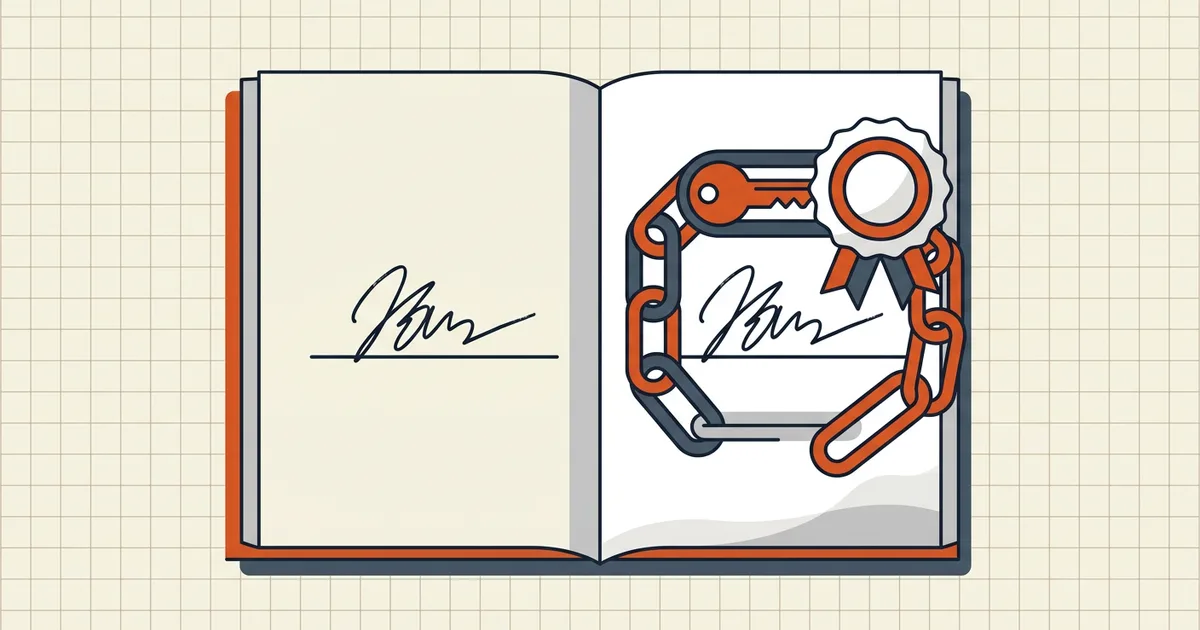
"Electronic signature" and "digital signature" are used interchangeably in marketing — and they name different things. One is a legal concept about intent. The other is a technology about integrity. Keeping them apart resolves most confusion about what a signed PDF actually proves.
The one-sentence split
- Electronic signature (e-signature): any electronic mark — typed name, drawn scribble, checked box — adopted with intent to sign the record.
- Digital signature: a cryptographic seal: a hash of the file's exact bytes signed with a certificate's private key, embeddable and later verifiable in the PDF.
The relationship is a subset: every digital signature is an electronic signature; most electronic signatures are not digital.

What each one proves
| Claim | Typed name / image | Click-to-agree + audit trail | Certificate-based digital signature |
|---|---|---|---|
| Shows intent to sign | By assertion | By assertion + logs | By assertion + key use |
| Tamper-evident after signing | No | Platform-dependent | Yes — mathematically |
| Tied to a specific certificate | No | Platform identity | Yes |
| Verifiable offline, years later | No | Needs the platform | Yes, with the certificate |
| Survives the platform disappearing | — | Audit trail at risk | Yes |
That last row matters more than people expect. An audit trail held by a vendor is evidence about a signature. A PKCS#7 signature embedded in the PDF is evidence in the file — readable by any compliant verifier forever (how verification works).
The legal layer (frameworks, not advice)
Two frameworks cover most questions people bring:
- United States — ESIGN Act (2000) and UETA (as adopted by states). Electronic signatures cannot be denied legal effect solely for being electronic; the tests center on intent, attribution, and record retention. Digital signatures strengthen the evidence for those tests (tamper-evident seal, certificate-bound attribution) rather than occupying a separate legal category.
- European Union — eIDAS (No. 910/2014). Defines three tiers: Simple (any e-signature), Advanced (uniquely linked to signer, detect-changes), and Qualified (created by a qualified signature-creation device with a qualified certificate — the tier with the strongest cross-border effect). A PKCS#7 certificate signature maps naturally to the advanced concept; "qualified" requires qualified certificates and devices.
Other jurisdictions have their own statutes with similar shapes: intent matters; stronger identity and tamper-evidence means stronger evidence. For a specific instrument — filings, notarizations, regulated-industry forms — ask what the receiving authority actually accepts.
Choosing in practice
- Internal approvals, NDAs, routine agreements: an e-signature workflow with authentication and a retained audit trail is usually sufficient — that's what the big click-to-sign platforms sell.
- Regulated filings, high-value instruments, anything you may need to prove later: a certificate-based digital signature on the final PDF gives self-contained tamper-evidence. BytesPDF Sign PDF computes real PKCS#7 signatures on your device — import a certificate or create a self-signed one for internal workflows.
- Both, layered: sign digitally at the PDF level and capture the e-signature ceremony (who clicked, when) as evidence alongside it. The secure contract workflow sequences this.
Frequently asked questions
What is the difference between an electronic signature and a digital signature?
An electronic signature is any electronic mark made with intent to sign — a typed name, a drawn signature, a click-to-agree. A digital signature is a cryptographic operation: a certificate's private key signs a digest of the file's exact bytes. All digital signatures are electronic signatures; most electronic signatures are not digital signatures.
Are both legally binding?
In many jurisdictions, yes — intent and consent are the core tests. U.S. law (the ESIGN Act and UETA) gives electronic signatures legal effect; the EU's eIDAS regulation defines tiers (simple, advanced, qualified). This article explains mechanics, not legal advice — for high-stakes instruments, confirm what your jurisdiction and counterparty require.
Is a typed name in a PDF a digital signature?
No. A typed name or signature image is an electronic signature at best — copyable and non-cryptographic. A digital signature binds a certificate to the file's bytes and breaks if the file changes.
Which do I need for a contract?
Most day-to-day agreements are valid with electronic signatures plus a good audit trail. Choose digital (certificate-based) signatures when regulation demands them, when tamper-evidence must be provable later, or when the file will be archived and re-verified.
Is a DocuSign-style click-to-sign a digital signature?
Click-to-sign products are electronic signatures; many platforms *add* a digital signature (their own certificate) when sealing the final document. Check what the sealed PDF actually contains — a signature panel showing certificate details means cryptography is present.